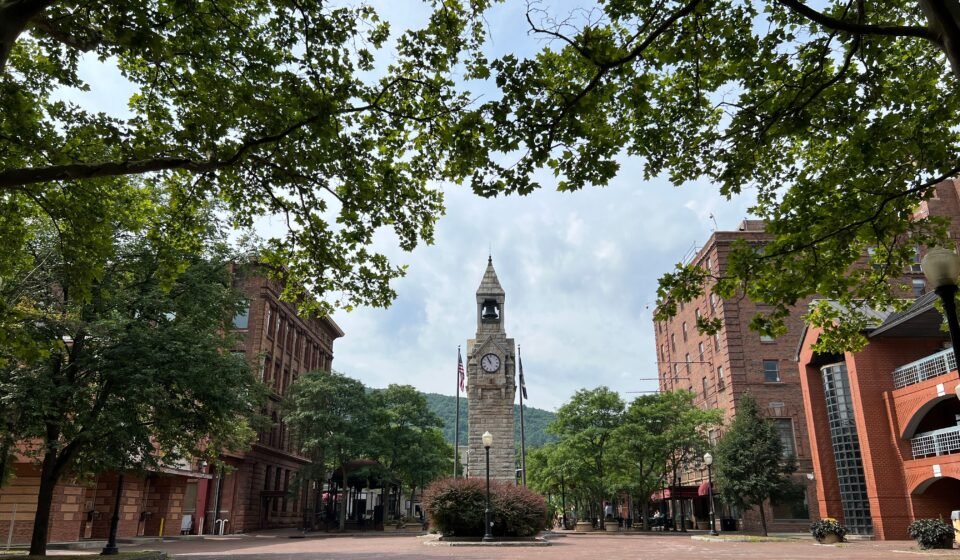

Centralia, Columbia County, Pennsylvania, is one of the most unusual places in the United States. Once a small coal-mining community of roughly 1,100 residents, Centralia became internationally known because of an underground mine fire that began in 1962 and has continued for decades. The fire transformed the community, damaged roads, caused dangerous ground conditions, and eventually led most residents to relocate. Today, Centralia is closely associated with Pennsylvania’s coal-mining history, abandoned mine hazards, and the long-running effort to manage the consequences of the fire.
Although Centralia is often described online as a “ghost town,” that label does not tell the whole story. The borough still exists, and a small number of properties remain. At the same time, the landscape is dramatically different from the thriving community that existed before the fire. Understanding Centralia requires looking at its coal-mining origins, the cause of the fire, the evacuation and relocation process, and the safety issues that remain today.
The History of Centralia, Columbia County, Pennsylvania
The story of Centralia began long before the famous mine fire. Pennsylvania’s coal industry shaped many communities throughout the state, and Centralia developed as a mining town in Columbia County.
According to the Pennsylvania Department of Environmental Protection, a settlement known as Bull’s Head was established in the area in 1811. It was later known as Centreville before becoming Centralia. Coal mining began in the area in 1842, while the Centralia Colliery opened in 1862. Centralia Borough was incorporated in the 19th century and developed around the coal industry.
For generations, coal provided employment and helped support businesses, homes, churches, schools, and other community institutions. Like many Pennsylvania mining towns, Centralia was closely connected to the underground coal reserves beneath it.
The geology beneath Centralia eventually became central to the community’s future. Extensive abandoned mine workings created pathways through which an underground fire could spread. Once the fire entered the coal-bearing formations, putting it out became far more complicated than extinguishing an ordinary surface fire.
Before 1962, Centralia was a functioning borough with hundreds of families and businesses. The Pennsylvania DEP estimates that approximately 1,100 to 1,200 people lived there when the mine fire began.
That makes the later transformation particularly striking. Centralia was not originally an abandoned settlement created by a disaster. It was an established community whose future was gradually changed by a fire beneath the ground.
How the Centralia Mine Fire Started
The Centralia mine fire began in May 1962 and became the defining event in the borough’s modern history.
The Pennsylvania Department of Environmental Protection reports that the fire reportedly began when residential trash was intentionally burned in an abandoned strip mine pit. The pit had been left open after earlier surface mining. According to the state’s account, the absence of a properly constructed noncombustible barrier allowed the fire to spread from combustible material into nearby coal mine workings.
The fire was first reported on May 27, 1962, shortly before Memorial Day. What appeared to be a relatively ordinary trash fire eventually became a deep underground coal fire.
The underground environment made the problem exceptionally difficult. Coal seams and abandoned mine passages could provide fuel and pathways for the fire. A fire below ground also cannot simply be approached with conventional firefighting equipment in the same way as a burning building.
During the years that followed, government agencies attempted various methods to control the fire. The Pennsylvania DEP’s chronology states that state and federal governments spent about $3.3 million on control efforts between 1962 and 1978, with limited results.
The situation demonstrated one of the major challenges associated with abandoned coal mines. When combustible material remains underground and the surrounding geology permits the movement of heat and gases, a fire can become a long-term environmental and public safety problem.
Why Centralia Became Nearly Empty
The mine fire did not cause Centralia to disappear overnight. The transformation occurred over many years as officials became increasingly concerned about hazards associated with the fire.
One of the most serious concerns was subsidence. As underground areas were affected by mining and the fire, sections of the ground could become unstable. Dangerous gases were another concern. The Pennsylvania DEP now warns that the immediate area affected by the Centralia Mine Fire can contain dangerous gases and that the ground may experience sudden and unexpected collapse.
The effects eventually reached transportation infrastructure. In 1983, Route 61 experienced severe subsidence damage related to the fire. The road was stabilized at significant cost, but the problem eventually contributed to its indefinite closure.
Federal funding for relocation followed. According to the state’s chronology, Congress appropriated $42 million in 1984 for voluntary acquisition and relocation of affected businesses and residences because of dangers associated with noxious gases and subsidence. Between 1985 and 1991, 545 residences and businesses were acquired and residents moved.
Relocation continued to be a complicated process. Some property owners resisted moving, while others accepted government acquisition offers. Legal proceedings continued into the 1990s.
The Pennsylvania DEP records that condemnation procedures were initiated against remaining properties in 1992 and 1993. By 1993, Route 61 was closed indefinitely because of fire damage.
This history is important because it explains why Centralia looks so different today. The community was not simply abandoned because people lost interest in living there. Large-scale relocation resulted from a prolonged public safety and environmental problem.
What Happened to Centralia’s Roads and Buildings?
One of the most recognizable symbols of Centralia is the damaged section of Route 61 that became known as the “Graffiti Highway.”
The road developed cracks and other damage as underground conditions affected the surface. Over time, the abandoned roadway became a destination for photographers, urban explorers, graffiti artists, and people interested in the unusual history of the town.
Photographs of the road helped turn Centralia into an internet-famous destination. However, the popularity of the site created its own safety problems. The Pennsylvania DEP strongly discourages people from entering the immediate mine-fire area because of potentially dangerous gases and sudden ground collapse.
The Graffiti Highway is also frequently misunderstood. It has been covered with earth to discourage public access. Smithsonian photography records the highway as a former attraction that was covered with piles of dirt to keep tourists away.
The physical appearance of Centralia has also changed because many homes and other structures were acquired and removed during the relocation process.
As buildings disappeared, vegetation gradually became more prominent. Streets that once served ordinary residential neighborhoods could eventually appear strangely quiet, with empty lots replacing homes.
This contrast is one reason Centralia attracts so much attention. A place that once had the characteristics of a normal Pennsylvania coal town became an unusual landscape shaped by decades of underground fire and government relocation.
Is the Centralia Mine Fire Still Burning?
Yes. The Centralia Mine Fire continues to burn in abandoned underground mine workings.
The Pennsylvania Department of Environmental Protection states that the fire has been burning in the abandoned deep mine workings of the Buck Mountain Coal Bed since May 1962. The state continues to monitor the situation as part of its abandoned mine reclamation responsibilities.
The exact underground behavior of a mine fire is much more complicated than simply saying that flames are burning beneath every part of the town. Underground fires can move through coal seams and mine workings, and conditions can vary across the affected area.
The state maintains maps and monitoring resources related to the Centralia fire. These include fire-location information, potential spread maps, gas monitoring information, temperature monitoring information, and historical mine maps.
This ongoing monitoring matters because underground mine fires can create multiple hazards. Heat, gases, unstable ground, and subsidence can all make affected areas dangerous.
For this reason, people should not treat Centralia as an ordinary abandoned-town sightseeing location. The Pennsylvania DEP specifically warns against walking or driving in the immediate mine-fire area.
The fact that Centralia is famous does not make every part of the area safe for exploration.
What Is Centralia Like Today?
Modern Centralia is very different from the community that existed before the mine fire.
The borough still exists as a legal and historical community, but most of its former population has relocated. Pennsylvania’s historical records document the enormous scale of the relocation program. The state’s chronology reports that 545 residences and businesses were acquired and residents moved during 1985 through 1991, with additional relocation actions continuing afterward.
Centralia is therefore better understood as a sparsely populated remnant of a former coal-mining community rather than a completely nonexistent town.
Its story remains visible in several ways. Empty spaces, remaining roads, historical properties, surrounding mine lands, and the broader landscape all provide evidence of what happened.
The town is also an important case study in Pennsylvania’s history of coal extraction. The state’s abandoned mine land program recognizes underground mine fires as a category of abandoned mine hazard.
For historians, Centralia demonstrates how closely communities can become tied to natural resources. Coal created jobs and helped establish the local economy, but abandoned mine workings later contributed to an environmental and safety crisis that fundamentally changed the community.
For visitors, however, the most important point is safety. The Centralia Mine Fire area is not an ordinary tourist attraction. Pennsylvania officials warn that dangerous gases may be present and that the ground can collapse unexpectedly.
Centralia’s Legacy and Frequently Asked Questions
Centralia, Columbia County, Pennsylvania, has become one of the best-known examples of how an abandoned mine can affect a community for generations. Its story combines industrial history, environmental hazards, government relocation, infrastructure damage, and the lasting consequences of coal mining.
The fire also illustrates why abandoned mines remain an important issue across Pennsylvania. The state’s abandoned mine reclamation program addresses hazards such as underground mine fires, subsidence, abandoned shafts, and other problems associated with historic mining.
Frequently Asked Questions
Where is Centralia, Pennsylvania?
Centralia is a borough in Columbia County, Pennsylvania. It is a former coal-mining community best known for the underground mine fire that began in 1962.
Why is Centralia famous?
Centralia became famous because of its long-burning underground coal mine fire. The fire led to dangerous ground conditions, concerns about gases and subsidence, major property acquisitions, and the relocation of most residents.
When did the Centralia mine fire start?
The Centralia Mine Fire began in May 1962. Pennsylvania DEP records identify May 27, 1962, as the date the fire was first reported.
Is Centralia still inhabited?
Yes. Centralia still exists as a borough, although its population is dramatically smaller than before the mine fire. Most residents were relocated through government acquisition and relocation programs.
Can you visit Centralia?
People can learn about Centralia and view areas around the former community, but the Pennsylvania DEP strongly discourages walking or driving in the immediate mine-fire area because of dangerous gases and the possibility of sudden ground collapse.
Can you see the underground fire?
The fire is primarily an underground phenomenon. Visible smoke or other signs have appeared in affected areas at various times, but visitors should not enter hazardous areas in an attempt to locate the fire.
What happened to Route 61 in Centralia?
Route 61 suffered severe subsidence damage associated with the mine fire. The Pennsylvania DEP reports that the road was eventually closed indefinitely in 1993.
What was the Graffiti Highway?
The Graffiti Highway was a damaged and abandoned section of Route 61 near Centralia that became known for graffiti and urban exploration. The area was later covered with dirt to discourage visitors from entering the hazardous site.
How long has the Centralia fire been burning?
The fire began in 1962 and remains an ongoing underground mine-fire problem. Pennsylvania continues to monitor the affected area.
Why was Centralia abandoned?
Centralia was not completely abandoned at once. Most residents were relocated over many years because of hazards associated with the underground fire, including dangerous gases and subsidence. The relocation program acquired hundreds of residences and businesses.
Final Thoughts
Centralia, Columbia County, Pennsylvania, is much more than an unusual location associated with an underground fire. It is a powerful example of Pennsylvania’s coal-mining heritage and the long-term challenges that can follow when abandoned mine workings become hazardous.
The community began as a coal town, grew around mining, and eventually became known around the world for a fire that has remained underground for more than six decades. The relocation of hundreds of homes and businesses changed Centralia permanently, while damaged infrastructure and dangerous ground conditions created a landscape unlike almost any other community in the United States.
Today, Centralia remains important for historians, researchers, photographers, and people interested in Pennsylvania’s industrial past. But its unusual reputation should not obscure the real safety risks. The Pennsylvania Department of Environmental Protection continues to warn that the immediate mine-fire area can contain dangerous gases and unstable ground.
The lasting lesson of Centralia is therefore both historical and practical. The town shows how natural resources can shape a community for generations, but it also demonstrates why abandoned mines require careful monitoring and responsible land management long after mining has ended.